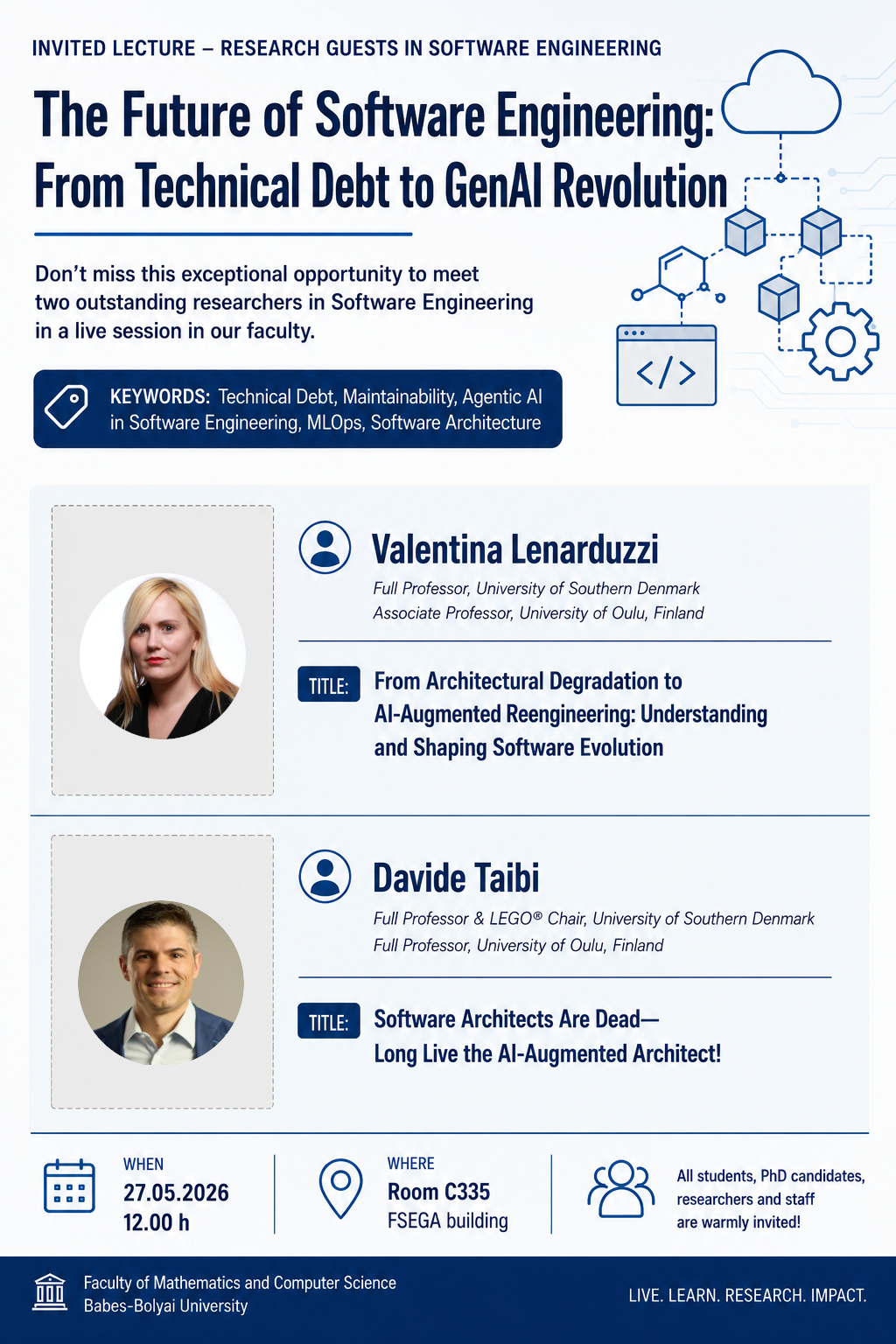
The Future of Software Engineering: From Technical Debt to GenAI Revolution
We invite you to a special research group session featuring two leading researchers in Software Engineering: Valentina Lenarduzzi and Davide Taibi.
Talks:
- Valentina Lenarduzzi: From Architectural Degradation to AI-Augmented Reengineering: Understanding and Shaping Software Evolution
- Davide Taibi: Software Architects Are Dead – Long Live the AI-Augmented Architect!
When: 27.05.2026, 12:00
Where: Room C335, FSEGA Building
Valentina Lenarduzzi: From Architectural Degradation to AI-Augmented Reengineering: Understanding and Shaping Software Evolution
Abstract: Software systems continuously evolve, often drifting away from their intended architecture and accumulating technical debt that threatens long-term maintainability and sustainability. Understanding and managing this evolution remains a central challenge in software reengineering. In this keynote, I present a research journey that investigates how architectural degradation emerges, how it can be measured through structural and behavioral indicators, and how developer-driven activities, such as refactoring, reflect the underlying system’s evolution dynamics.
Building on empirical evidence from large-scale studies, I discuss how signals such as centrality change-proneness, coupling, and admitted technical debt provide early warnings of architectural decay. I further explore how recent advances in Large Language Models enable a new class of AI-augmented reengineering approaches that support tasks such as detecting architectural violations, interpreting refactoring motivations, and assisting decision-making processes.
Finally, I outline a vision for the future of software reengineering, where AI moves from passive analysis to active participation, enabling semi-autonomous and autonomic evolution of software systems. This shift opens new opportunities, but also raises critical challenges related to trust, control, and the role of humans in the loop.
Valentina Lenarduzzi is a Full Professor at the University of Southern Denmark and Associate Professor at the University of Oulu, Finland. She has a strong international profile in empirical software engineering, with research focused on software quality, software maintenance and evolution, and Technical Debt. Her work also addresses modern software engineering challenges such as the growing role of Generative AI and large language models in software development, including their use for architectural decision-making and software refactoring analysis. She has extensive scientific impact and has built a strong academic and professional network through collaborations and visiting positions. She has held major organizational responsibilities in the software engineering community, including General Co-chair of SANER2024 and PROFES2025, and Program Co-chair of PROFES2023, SEAA2024, ESOCC2025 and ESEM2025. Moreover, she is Steering committee member of ESEM, PROFES and SANER.
Davide Taibi: Software Architects Are Dead – Long Live the AI-Augmented Architect!
Abstract: What if the future of software architecture doesn’t need architects as we know them? As GenAI infiltrates every stage of the software development lifecycle, the traditional role of the architect – meticulously designing systems from requirements to deployment – is being unbundled, redefined, and partially outsourced to machines. And yet, the industry is far from ready. This keynote presents a bold vision of the AI-Augmented Architect: a hybrid thinker who doesn’t write blueprints alone but designs with AI, using it not as a tool – but as a creative partner, a challenger, a simulator of trade-offs. Drawing from two cutting-edge empirical studies, including a multivocal review of GenAI in software architecture and a forward-looking survey of industry leaders, we’ll confront hard truths: AI is already doing architectural documentation, detecting antipatterns, and even suggesting design alternatives. But it’s also hallucinating, biasing decisions, and eroding accountability. If we don’t rethink our roles, methods, and mindset, software architects risk becoming passive validators of AI output rather than strategic designers of complex systems. The good news? There is still time to adapt – but only if we embrace a future where architecture is not less human, but more profoundly human because of our collaboration with machines.
Davide Taibi is Full professor and LEGO® Chair at the University of Southern Denmark and Full Professor at the University of Oulu, Finland. He has a strong international profile in software architecture, with research focused on software quality in cloud-based systems, supporting companies in the migration process to cloud-native architectures. His work also addresses software refactoring and modernization, cloud-related patterns, anti-patterns, and “bad smells” that can help companies to avoid issues during the development process both in monolithic systems and in cloud-native ones.
He has extensive scientific impact and has built a strong academic and professional network through collaborations and visiting positions. He has held major organizational responsibilities in the software engineering community, including General Co-chair of SANER2024 and ECSA2026, and ICSA2028, and Program Co-chair of PROFES2022 and SEAA2025. Moreover, he is Steering committee member of ECSA.