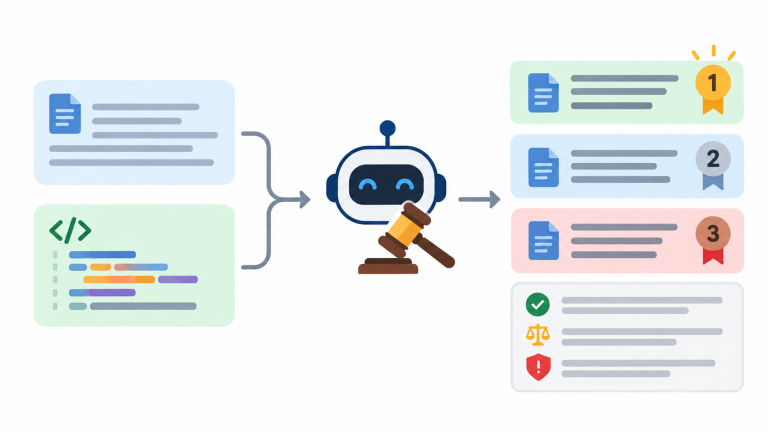
Comparative Analysis of LLMs for Software Quality Assessment via Code and Metrics (2026)

Proceedings of the 18th International Conference on Agents and Artificial Intelligence Authors L. Cernau, A. Dobrescu, Ecaterina Cărbune, Georgiana Asandei Abstract The use of large language models (LLMs) to analyse and identify errors in code is becoming increasingly common among developers. While many studies aim to improve the quality and effectiveness of LLM-generated code,…

Polarity Related Influence Maximization through Multi-Agent Reinforcement Learning (2026)

Proceedings of the 18th International Conference on Agents and Artificial Intelligence Authors Anikó Kopacz, Camelia Chira Abstract Influence maximization is a network optimization problem, which consists of selecting nodes as sources while maximizing the spread of information. The source nodes that are initially activated form the seed set. Polarity-related influence maximization accounts for having…

An Analysis of Multi-Task Architectures for the Hierarchic Multi-Label Problem of Vehicle Model and Make Classification (2026)

arXiv.org Authors Alexandru Manole, Laura Diosan Abstract Most information in our world is organized hierarchically; however, many Deep Learning approaches do not leverage this semantically rich structure. Research suggests that human learning benefits from exploiting the hierarchical structure of information, and intelligent models could similarly take advantage of this through multi-task learning. In this…

TF3-RO-50M: Training Compact Romanian Language Models from Scratch on Synthetic Moral Microfiction (2026)

Recent advances in synthetic data generation have shown that compact language models can be trained effectively when the underlying corpus is structurally controlled and linguistically coherent. However, for morphologically rich and computationally under-resourced languages such as Romanian, there is still no openly documented, end-to-end pipeline that unifies tokenizer design, preprocessing, pretraining, compression, evaluation, and…

Building Large-Scale English-Romanian Literary Translation Resources with Open Models (2025)

Literary translation has recently gained attention as a distinct and complex task in machine translation research. However, the translation by small open models remains an open problem. We contribute to this ongoing research by introducing TINYFABULIST TRANSLATION FRAMEWORK (TF2), a unified framework for dataset creation, fine-tuning, and evaluation in English-Romanian literary translations, centred on…

Using Community Detection in Adolescent Media Multitasking Research. An Exploratory Study (2025)

In this exploratory study, we used the community detection approach to complex networks analysis to analyze temperamental and executive functioning profiles of media multitaskers in early adolescence. Media multitasking is particularly intense in adolescence (Smahel et al., 2020), with implications for short- and long-term functioning (van der Schuur et al., 2015, 2020). Temperament and…

Evaluating Deep Learning Models for Cross-Platform UI Component Detection: A Study Across Web, Desktop, and Mobile Interfaces (2025)

User interfaces look different across web, desktop, and mobile platforms — not just in layout, but in how buttons, icons, and text appear. This makes it hard for deep learning models trained on one platform to accurately detect UI components on another. In this paper, we evaluate the cross-domain generalization of three modern object…

Synthetic Data Generation Using Large Language Models: Advances in Text and Code (2025)

This survey reviews how large language models (LLMs) are transforming synthetic training data generation in both natural language and code domains. By producing artificial but task-relevant examples, these models can significantly augment or even substitute for real-world datasets, particularly in scenarios where labeled data is scarce, expensive, or sensitive. This paper surveys recent advances…