
Polarity Related Influence Maximization through Multi-Agent Reinforcement Learning (2026)

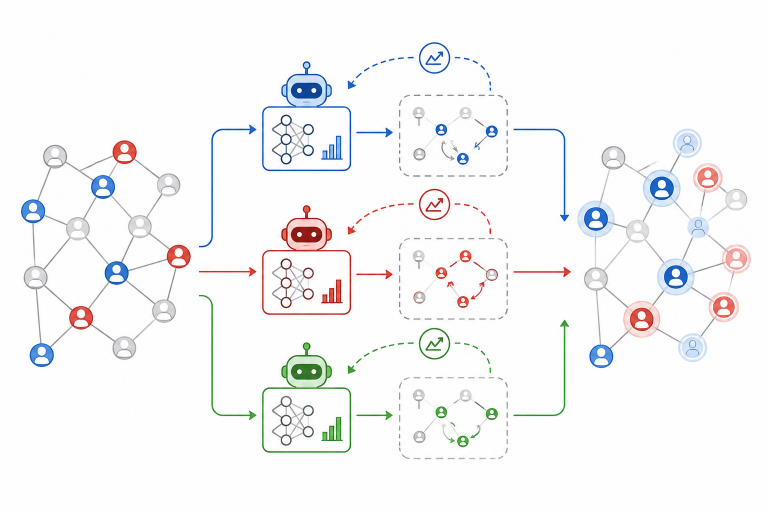
Proceedings of the 18th International Conference on Agents and Artificial Intelligence Authors Anikó Kopacz, Camelia Chira Abstract Influence maximization is a network optimization problem, which consists of selecting nodes as sources while maximizing the spread of information. The source nodes that are initially activated form the seed set. Polarity-related influence maximization accounts for having…

Competitive Influence Maximization in Trust-Based Social Networks With Deep Q-Learning (2024)

Social network analysis is a rapidly evolving research area having several real-life application areas, e.g. digital marketing, epidemiology, spread of misinformation. Influence maximization aims to select a subset of nodes in such manner that the information propagated over the network is maximized. Competitive influence maximization, which describes the phenomena of multiple actors competing for…

Evaluating cooperative-competitive dynamics with deep Q-learning (2023)

We model cooperative-competitive social group dynamics with multi-agent environments, specialized in cases with a large number of agents from only a few distinct types. The multi-agent optimization problems are addressed in turn with multi-agent reinforcement learning algorithms to obtain flexible and robust solutions. We analyze the effectiveness of centralized and decentralized algorithms using three…

Standardized feature extraction from pairwise conflicts applied to the train rescheduling problem (2022)

We propose a train rescheduling algorithm which applies a standardized feature selection based on pairwise conflicts in order to serve as input for the reinforcement learning framework. We implement an analytical method which identifies and optimally solves every conflict arising between two trains, then we design a corresponding observation space which features the most…

Applying Deep Q-learning for Multi-agent Cooperative-Competitive Environments (2022)

Cooperative-competitive social group dynamics may be modelled with multi-agent environments with a large number of agents from a few distinct agent-types. Even the simplest games modelling social interactions are suitable to analyze emerging group dynamics. In many cases, the underlying computational problem is NP-complex, thus various machine learning techniques are implemented to accelerate the…