
Evaluating Deep Learning Models for Cross-Platform UI Component Detection: A Study Across Web, Desktop, and Mobile Interfaces (2025)

Procedia Computer Science Authors Madalina Dicu, Camelia Chira Abstract User interfaces look different across web, desktop, and mobile platforms — not just in layout, but in how buttons, icons, and text appear. This makes it hard for deep learning models trained on one platform to accurately detect UI components on another. In this paper,…

Synthetic Data Generation Using Large Language Models: Advances in Text and Code (2025)

IEEE Access Authors Mihai Nadǎş, Laura Dioşan, Andreea Tomescu Abstract This survey reviews how large language models (LLMs) are transforming synthetic training data generation in both natural language and code domains. By producing artificial but task-relevant examples, these models can significantly augment or even substitute for real-world datasets, particularly in scenarios where labeled data…

Unveiling Hybrid Cyclomatic Complexity: A Comprehensive Analysis and Evaluation as an Integral Feature in Automatic Defect Prediction Models (2025)

arXiv.org Authors L. Cernau, L. Dioşan, Camelia Serban Abstract The complex software systems developed nowadays require assessing their quality and proneness to errors. Reducing code complexity is a never-ending problem, especially in today’s fast pace of software systems development. Therefore, the industry needs to find a method to determine the qualities of a software…

TF1-EN-3M: Three Million Synthetic Moral Fables for Training Small, Open Language Models (2025)

arXiv.org Authors Mihai Nadǎş, Laura Dioşan, Andrei Piscoran, Andreea Tomescu Abstract Moral stories are a time-tested vehicle for transmitting values, yet modern NLP lacks a large, structured corpus that couples coherent narratives with explicit ethical lessons. We close this gap with TF1-EN-3M, the first open dataset of three million English-language fables generated exclusively by…

Small Open Models Achieve Near Parity with Large Models in Low Resource Literary Translation at a Fraction of the Cost (2025)

arXiv.org Authors Mihai Nadǎş, Laura Dioşan, Andreea Tomescu, Andrei Piscoran Abstract Literary translation has recently gained attention as a distinct and complex task in machine translation research. However, the translation by small open models remains an open problem. We contribute to this ongoing research by introducing TINYFABULIST TRANSLATION FRAMEWORK (TF2), a unified framework for…

Textural analysis and artificial intelligence as decision support tools in the diagnosis of multiple sclerosis – a systematic review (2025)

Frontiers in Neuroscience Authors Filip Orzan, Ș. Iancu, L. Dioşan, Z. Bálint Abstract Introduction Magnetic resonance imaging (MRI) is conventionally used for the detection and diagnosis of multiple sclerosis (MS), often complemented by lumbar puncture—a highly invasive method—to validate the diagnosis. Additionally, MRI is periodically repeated to monitor disease progression and treatment efficacy. Recent…

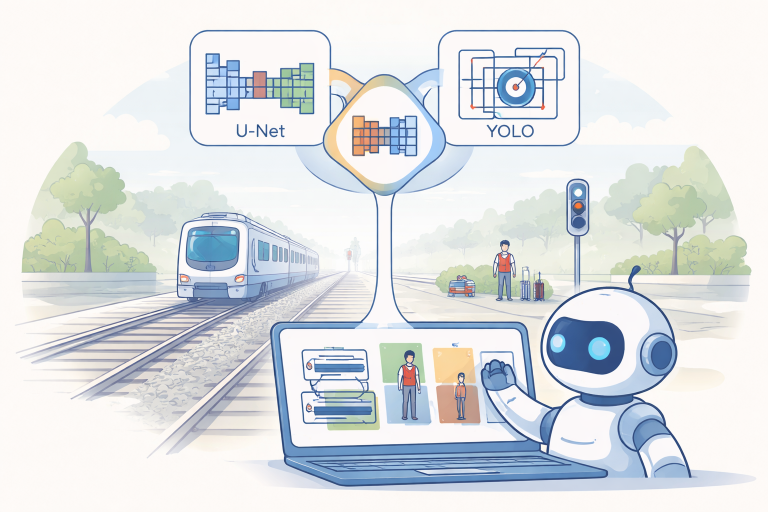
UOLO: A Multitask U-Net YOLO Hybrid Model for Railway Scene Understanding (2025)

IEEE Transactions on Intelligent Vehicles Authors Alexandru Manole, Laura Diosan Abstract Extracting essential information including the topological structure of rail-tracks, the position of switches and their current state can increase safety by reducing human error, while also boosting the efficiency of rail transportation. Despite the impressive advancements in the field of autonomous driving, computer…

ContRail: Realistic Railway Image Synthesis using ControlNet (2025)

Procedia Computer Science Authors Andrei-Robert Alexandrescu, Răzvan-Gabriel Petec, Alexandru Manole, Laura Diosan Abstract Deep learning became an ubiquitous paradigm due to its extraordinary effectiveness and applicability in numerous domains. However, the approach suffers from the high demand for data required to achieve the potential of this type of model. An ever-increasing subfield of Artificial…

Analyzing the Impact of Data Augmentation on Tumor Detection and Classification in Mammograms (2025)

Hybrid Artificial Intelligence Systems Authors Madalina Dicu, Enol García González, Camelia Chira, José R. Villar Abstract Breast cancer remains one of the leading causes of mortality among women worldwide, making early detection crucial for improving survival rates. Deep learning-based approaches have shown remarkable potential in automating tumor detection from mammographic images; however, their effectiveness…